

NATO suspends top Spanish arms firm over “irregularities”
The alliance’s procurement arm suspended Fábrica de Municiones de Granada last summer over suspected irregularities in ammunition contracts, according to an investigation by La Lettre and its partners. Its owner, the giant Czechoslovak Group, did not deem it necessary to disclose this awkward fact at the time of its spectacular stock market flotation in January.
Publié le 10/03/2026 à 6h20 Lecture 4 minutes Matthieu Fauroux
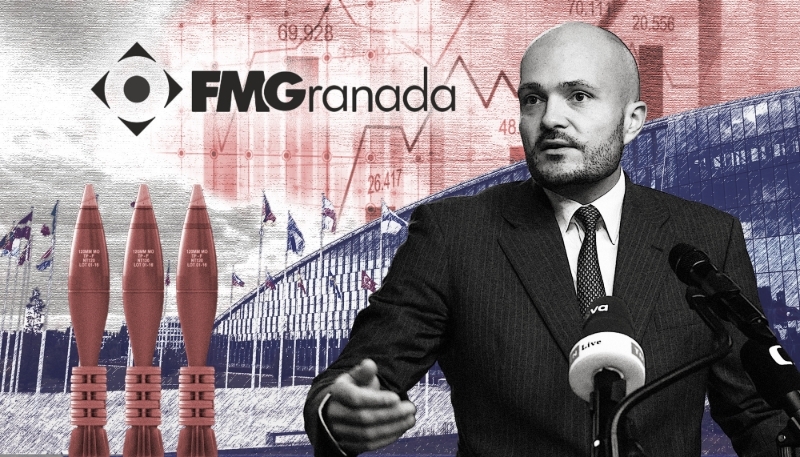
Michal Strnad, chairman of Czechoslovak Group, parent company of Fábrica de Municiones de Granada.
Michal Strnad, chairman of Czechoslovak Group, parent company of Fábrica de Municiones de Granada. © Photomontage Indigo Publications – Piroschka van de Wouww/Reuters//Simon Wohlfahrt/AFP//FMG//sittipong phokawattana/iStock
Fábrica de Municiones de Granada (FMG), the Spanish specialist in tank and mortar ammunition, was suspended on 31 July by the NATO Support and Procurement Agency (NSPA). This highly unusual move cuts FMG off from arms markets in the alliance’s member states. According to documents seen by La Lettre and its Dutch and Belgian media partners Follow the Money, Le Soir and Knack, the decision was prompted by suspicions of “irregularities” across several of the agency’s programmes. The NSPA procured nearly €10bn in arms for NATO forces last year.
Since February 2025, a series of major defence contracts has been tainted by multiple corruption cases that have led to the arrest of around half a dozen intermediaries, agents and former NATO officials in Switzerland, the Netherlands and Italy (LL, 20/10/25). Many NSPA contracts are currently under investigation by Belgian, Luxembourgish and US prosecutors, and relate to ammunition, a market that has surged across Europe since Russia’s offensive in Ukraine began.
According to our sources, the three FMG contracts under scrutiny involve 120mm shells, a calibre used in French Leclerc, American Abrams and German Leopard 2 tanks. The procedure barring the Spanish company from NSPA tenders was issued on the same day as one targeting Elbit Systems, the Israeli defence giant, one of whose intermediaries is currently being sought by Belgian prosecutors (LL, 08/12/25).
‘Sanctionable practices’
On 31 July, Céline Danielli, the head of the NSPA’s ammunitions programme, wrote to NATO member states to explain that the two suspensions followed “the emergence of serious allegations indicating that it is likely the suppliers engaged in sanctionable practices, including irregularities in the award of contracts”.
At the time, Danielli advised member states to contact the Belgian federal police’s anti-corruption unit for further details, before closing her letter on an unsettling note: “It is possible that other companies might undergo the same process in the near future.”
FMG is well known in the defence industry. It posted €163m in revenue in 2024 and is a major customer of French propellant manufacturer Eurenco, with which it forged a partnership in June 2022, announced in Paris at the Eurosatory trade show. Spain’s second-largest ammunition maker made headlines on 23 January, when its parent company, Czechoslovak Group (CSG), completed a high-profile IPO on the Amsterdam stock exchange. The Czech munitions heavyweight, which also owns the MSM Group, Fiocchi and Remington and sold more than €6bn of arms and ammunition in 2025, caught the eye of US fund BlackRock and retail investors alike. Shares in the company, led by Michal Strnad, surged by a sector-record 31.4% on the first day of trading, giving it a market capitalisation of $35bn.
A scandal kept under wraps
In the prospectus issued ahead of the listing, CSG made no mention of its Spanish subsidiary’s suspension by NATO in connection with possible “fraudulent activities.” European law requires a company to inform investors even of a threat of criminal investigation if it constitutes “material to an investor.”
A CSG spokesman said that “based on the internal audit results, FMG believes it has done nothing wrong, committed no wrongdoing, or taken any part in any uncompliant activities, that could have led to said suspension” by NATO. The Czech company does, however, offer an explanation: “FMG believes the suspension could be linked to an investigation by the NSPA and Belgian authorities of one particular NSPA case officer.” The group maintains that the suspension has had no significant financial impact on its operations.
Backdoor lobbying
On 11 December, the NSPA acknowledged on its website that it had “temporarily suspended companies in NATO and non-NATO Nations based on ongoing national investigations or NSPA investigative efforts, where preliminary evidence suggests sanctionable practices have taken place”.
The matter was deemed serious enough to warrant a formal communication to the North Atlantic Council. Yet the agency has never made public the list or status of the companies affected. Several of them have quietly launched lobbying efforts targeting agency management and member-state capitals in a bid to regain access to NATO tenders.
According to our sources, FMG sought to persuade the agency’s leadership of its good faith, but has so far failed to get off NSPA’s list of suspended companies. Global Defense Logistics, another suspended firm – whose maritime fuel contracts are the subject of US and Romanian investigations (LL, 20/10/25) – has also contacted each member state’s representative at the NSPA to make the case for its reinstatement.
NATO programmes under strain
The suspensions are complicating the delivery of NATO programmes at a time when member states’ orders are rising amid a broader European rearmament drive. In an internal letter dated 15 December 2025, NSPA director general Stacy Cummings acknowledged having “taken steps to ensure that the Agency’s ability to deliver operational support from previous or current contracts is not affected.”
As La Lettre and its partners have reported, Elbit Systems is also caught up in the suspensions (LL, 08/12/25). The Haifa-based company is a key supplier to the armed forces of NATO members, delivering anti-missile systems for Airbus’s A330 MRTT tanker, Embraer’s C-390 transport aircraft and the A330 presidential jet used by Emmanuel Macron, as well as small-calibre ammunition to the French military. Yet as with all other companies suspended by the NSPA, nothing prevents Elbit Systems or FMG from selling their weapons directly to states, bypassing the alliance’s tender process entirely. Multiple approaches to NATO and to the Belgian federal prosecutor failed to elicit responses to our questions.